The fastest way to kill a great reception is not bad music – it’s bad timing. A room can look beautiful, the food can be excellent, and your guest list can be perfect, but if the night feels rushed, awkward, or scattered, people notice. That’s exactly why couples ask how to build reception timeline in a way that keeps the energy up and the stress down.

A strong reception timeline is not about stuffing every tradition into one night. It’s about creating a pace that feels natural for your guests and realistic for your vendors. The best timelines leave room for real moments, not just scheduled ones.

How to build reception timeline around the guest experience

Start with one question: what do you want the room to feel like from start to finish? Some couples want a formal, elegant flow with a big grand entrance and a packed dance floor after dinner. Others want a more relaxed party where guests mingle, eat, and dance without too many interruptions. Both can work. What matters is that your timeline supports that vibe instead of fighting it.

Think about energy in waves. Guests arrive with curiosity and social energy. That is a good time for cocktail hour, light interaction, and photos if needed. Once everyone is seated, attention is usually strongest during introductions and the first major moments. After that, dinner creates a natural dip. Then you build the room back up with toasts, formal dances, or an opening dance set that invites people in.

This is where many receptions get off track. Too many formalities stacked together can make the night feel like a program instead of a celebration. On the other hand, waiting too long for dancing can make guests check out early, especially older family members or guests with kids.

Start with your non-negotiables

Before you assign times, decide what absolutely needs to happen. That usually includes your grand entrance, first dance, parent dances, blessing, dinner service, toasts, cake cutting, and open dancing. You may also have cultural traditions, bilingual announcements, a Hora Loca set, anniversary dance, bouquet toss, or surprise performance.

Not every reception needs all of that. In fact, trimming the list often improves the night. If a tradition feels forced, it can interrupt momentum instead of adding meaning. Keep the moments that matter to you and let the rest go.

Once you know your must-haves, put them in the order that makes emotional and logistical sense. For example, toasts are often better before dancing gets fully underway. Cake cutting can happen later, but not so late that half the room misses it. Parent dances can feel more special near the start of the reception, when everyone is still focused.

Build your timeline from the venue and catering backward

If you want to know how to build reception timeline realistically, start with the pieces that are least flexible. Your venue end time matters. Your catering schedule matters. Sunset matters if you want outdoor portraits. Once those anchors are in place, everything else becomes easier.

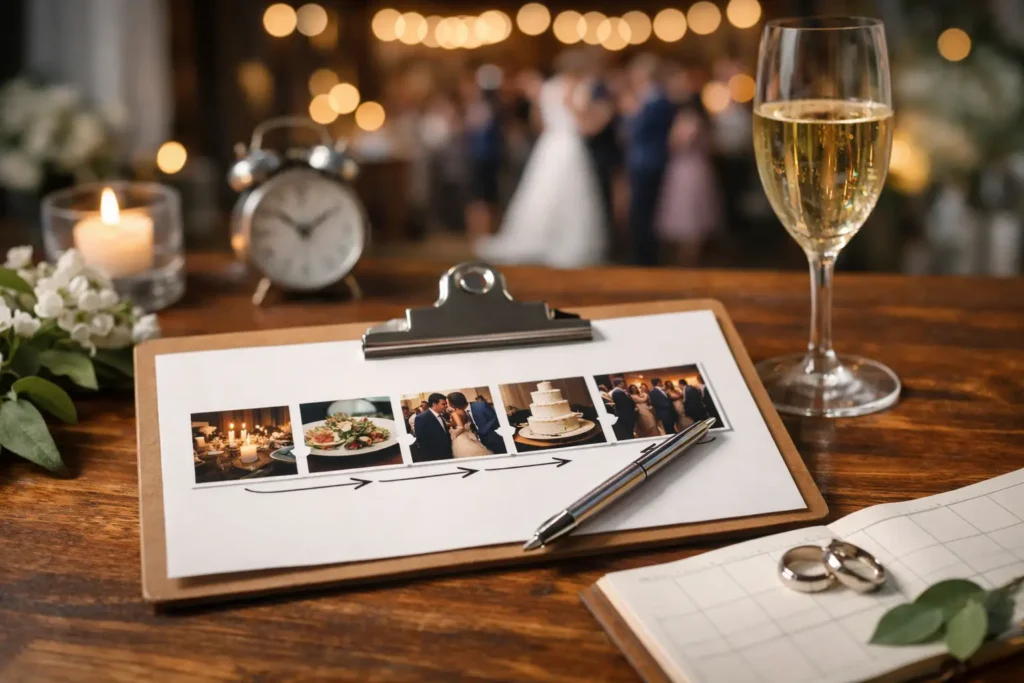
Let’s say your reception runs from 6:00 PM to 11:00 PM. Cocktail hour may be 6:00 to 7:00. Guests are then invited into the ballroom, with introductions around 7:05. First dance could happen immediately after, followed by welcome remarks and dinner service starting by 7:20. Toasts may fit best between courses or after the main course, depending on your caterer’s rhythm.

This is why entertainment and catering should never plan in separate lanes. A great DJ or MC is not just there to play songs. They help keep the night moving at the right speed, coordinate announcements with service, and read when the room is ready for the next moment.

If dinner service takes longer than expected, your timeline needs breathing room. If your photographer needs ten extra minutes for a golden-hour shot, that should not throw the entire night into chaos. Good planning includes flexibility on purpose.

A sample reception flow that works for many weddings

There is no single perfect timeline, but there is a rhythm that works well for a lot of receptions:

Cocktail hour opens the night. Guests settle in, grab a drink, and connect. Then the grand entrance brings everyone together and shifts the room into celebration mode. First dance follows while attention is high. Parent dances can happen here too, or after dinner if you want a softer transition.

Dinner should begin before guests get restless. Toasts often land well during dinner, especially once everyone has food and is seated. After dinner, you open the dance floor with intention. This is when the MC matters, the music matters, and the room-reading matters. A packed dance floor rarely happens by accident.

Cake cutting usually works best once dancing is already established, not before the party has started. It creates a nice reset without draining energy if handled quickly. From there, you move back into open dancing, any late-night feature moments, and your final song.

That general format works because it balances attention-based moments with movement-based ones. Guests are not stuck sitting too long, and you are not interrupting the dance floor every ten minutes.

How to build reception timeline without overbooking the night

One of the biggest mistakes couples make is assuming every moment only takes five minutes. It almost never does. Introductions can run longer if your wedding party is large. Toasts can stretch. Guests take time to move from one space to another. Even lining up for formal dances or gathering around the cake takes longer in real life than it does on paper.

A better approach is to give each major event a realistic window. If something finishes early, great – that extra time becomes more dancing, more mingling, or a chance to breathe. If something runs long, you are still protected.

It also helps to think about guest attention span. Three special moments in a row can feel polished. Six in a row can feel like homework. If you have a lot of formalities, break them up. Let the room breathe between them.

The timing of dancing matters more than most people expect

If your goal is a high-energy reception, the dance floor should not be treated like the leftover part of the night. It needs enough time to build. Guests usually need one strong invitation moment, then a few songs to warm up, and then the floor starts to fill.

That means if your formal events eat up most of the schedule and dancing does not start until very late, you are making the party work harder than it should. This matters even more for mixed-age crowds, multicultural weddings, and receptions with guests who may not stay until the very end.

For some couples, splitting the dancing into phases works well. You may do a short opening set after dinner, pause briefly for cake cutting or a special feature, then launch into the longer party block. This keeps momentum going while still making room for the moments you care about.

Your vendor team should help protect the timeline

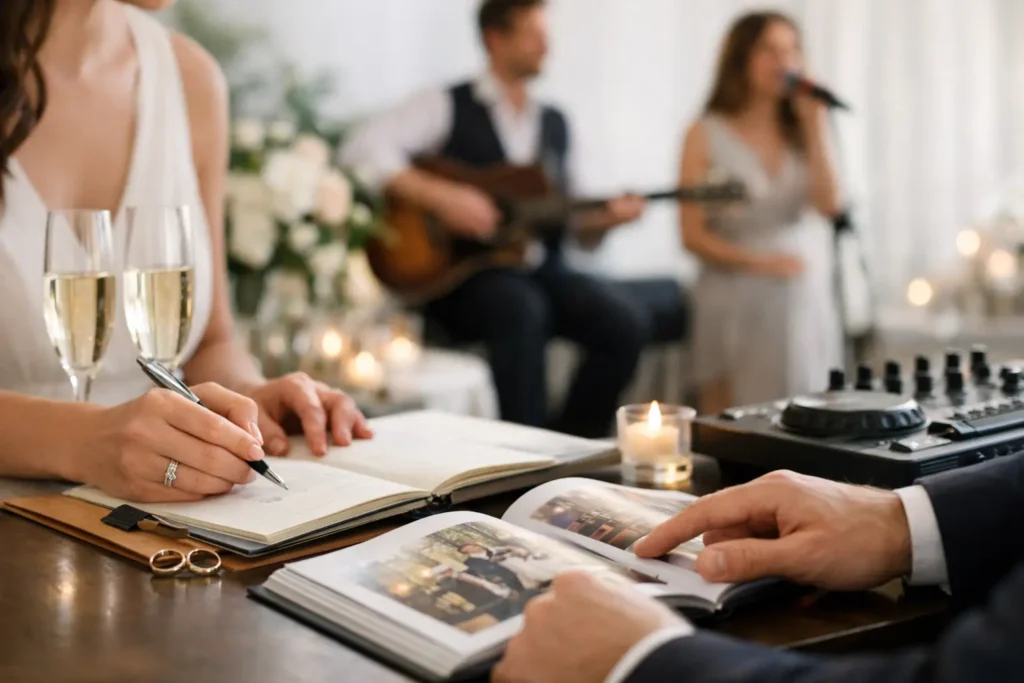
The best reception timelines are collaborative. Your planner, venue coordinator, caterer, photographer, videographer, DJ, and MC should all understand the same version of the night. If one vendor has a different order or different timing, confusion shows up fast.

That is why experienced entertainment teams are so valuable. They are watching the room in real time, making adjustments, and helping transitions feel smooth instead of awkward. At Electrified DJ Services, that kind of coordination is a huge part of what makes a celebration feel polished rather than pieced together.

This is especially helpful for bilingual weddings or events with cultural traditions that need clear announcements and strong pacing. When those moments are handled confidently, guests stay engaged instead of wondering what is happening next.

Leave space for the night to feel real

A reception timeline should guide the party, not control every breath of it. If your aunt grabs you for a photo, if your college friends start a chant on the dance floor, if dinner runs ten minutes behind, the night is not ruined. It is alive.

The goal is not perfection. The goal is flow. Build a timeline that protects the key moments, respects your guests, and leaves enough room for joy to show up naturally.

When you get that part right, the reception does not just stay on schedule. It feels easy, exciting, and memorable for everyone in the room.

The wrong DJ can make a beautiful wedding feel flat by 8:30. The right one can keep your timeline moving, your guests engaged, and your dance floor full without making the night feel forced. If you’re figuring out how to choose wedding DJ services, you’re not just hiring someone to play music. You’re choosing the person who helps shape the energy of your entire reception.

That’s why this decision deserves more than a quick price comparison. A wedding DJ is part entertainer, part MC, part crowd reader, and part event quarterback. The best fit for your wedding is the one who understands your style, communicates clearly, and knows how to keep the room connected from introductions to the last song.

How to Choose Wedding DJ Services Based on the Full Event

A lot of couples start with music taste, which makes sense, but that’s only one piece of the job. A wedding DJ also manages pacing, transitions, announcements, and the overall feel in the room. If your DJ can’t guide the night with confidence, even a great playlist won’t save the experience.

Start by thinking about what you want your reception to feel like. Do you want elegant and polished, high-energy and interactive, or a mix that builds naturally as the night goes on? Some DJs are strong club-style mixers. Others are excellent MCs but less dynamic musically. Some are better at reading a mixed-age crowd and balancing different tastes without losing momentum. There isn’t one right style. There’s only the style that fits your wedding.

This matters even more for multicultural weddings, bilingual celebrations, and events with a wide age range. A DJ who can move comfortably between genres, make guests feel included, and pronounce names correctly brings real value. If your wedding includes Latin music, Spanish-language announcements, or specialty moments like Hora Loca, experience in those areas is not a bonus. It’s part of the job.

Don’t Shop by Price First

Budget matters. Of course it does. But wedding DJ pricing can be misleading if you compare packages without looking at what’s actually included.

One company may quote a lower number and only cover basic music for a set block of time. Another may include planning meetings, MC services, ceremony audio, lighting, cocktail hour coverage, and a backup plan if equipment fails. On paper, both are “DJ services.” In reality, they’re offering very different levels of support.

The cheapest option often becomes expensive in other ways. Maybe you need to rent separate sound for the ceremony. Maybe the DJ is hard to reach during planning. Maybe they don’t coordinate with the venue and photographer, so key moments feel rushed or awkward. Weddings move fast, and when entertainment isn’t organized, everyone feels it.

A better question than “What do you charge?” is “What does your package actually cover from start to finish?” That opens the door to a more honest conversation.

What to Ask Before You Book

A strong consultation should leave you feeling clearer, not more confused. You want direct answers, confidence without arrogance, and a sense that this company runs weddings regularly.

Ask who will actually DJ your event. This sounds obvious, but it matters. Some companies book the event under one name and assign the DJ later. That setup isn’t always bad, especially if the team is trained well, but you should know who is leading your reception and whether you’ll have a chance to speak with them in advance.

Ask how they handle the flow of the night. An experienced wedding DJ should be able to talk through ceremony cues, introductions, first dances, toasts, dinner music, open dancing, and the transitions in between. If they only focus on the party portion, that’s a red flag.

Ask how they read a crowd. This is one of the biggest differences between an average DJ and a great one. A packed dance floor usually doesn’t happen because someone hit play on a hot playlist. It happens because the DJ knows when to switch genres, when to let a song breathe, when to shorten a track, and when to pivot if the room changes.

Ask about backup plans too. Professional entertainment companies should have backup equipment and a plan for emergencies. Weddings are too important for guesswork.

Reviews Help, but the Right Details Matter More

Five-star reviews are useful, but not all reviews tell you the same thing. Look for comments that mention specific results. Did the DJ keep the dance floor moving? Did they help the night stay on schedule? Were they easy to work with? Did guests talk about the entertainment afterward?

The best reviews often mention both energy and professionalism. That combination is what couples usually need most. High energy alone can feel chaotic. Professionalism alone can feel stiff. A great wedding DJ knows how to bring excitement while staying in control of the room.

If you’re planning in North Jersey, local experience can help more than people realize. A DJ who knows the pace of local venues, the expectations of area couples, and how to work smoothly with nearby vendors has an advantage. That kind of familiarity can reduce stress behind the scenes, which shows up as a smoother event for you and your guests.

Music Style Matters, but Flexibility Matters More

Most couples walk into the search with a few music goals. Maybe you want a throwback-heavy dance set, clean edits for a family crowd, a strong mix of current hits, or a balance of American, Latin, and international music. All of that should be part of the conversation.

Still, flexibility matters just as much as preference. Weddings are one of the few events where your college friends, grandparents, coworkers, and little cousins are all in the same room. A DJ who only plays one lane well may struggle once the floor shifts. The best wedding DJs can honor your must-plays and do-not-plays while adjusting in real time.

That’s also why pre-made sample playlists only tell you so much. They can show taste, but they don’t show timing. And timing is everything at a wedding. A song that works at 10:15 might fall flat at 8:45. An experienced DJ understands that the right song at the wrong moment is still the wrong song.

How to Choose Wedding DJ Add-Ons Without Overbooking

Couples often ask whether they should bundle lighting, photo booths, ceremony sound, or videography with their DJ package. Sometimes the answer is yes. Sometimes it isn’t.

The biggest advantage of bundling is coordination. When one trusted team handles multiple parts of the entertainment experience, planning gets easier. Your timeline is cleaner, communication is simpler, and the event tends to feel more connected. That can be a huge win if you’re trying to avoid managing a long list of separate vendors.

The trade-off is that you still need quality in each category, not just convenience. If a company offers uplighting, photo booths, or media coverage, ask how those services are staffed and managed. You want an all-in-one experience that feels polished, not a package that stretches one team too thin.

For many weddings, the smartest add-ons are the ones guests actually feel. Good ceremony audio prevents awkward missed moments. Smart lighting can completely change the room once dancing starts. A photo booth can give non-dancers something fun to do without pulling energy away from the main party. The key is choosing upgrades that support your guest experience, not just your Pinterest board.

Pay Attention to the Vibe During the Consultation

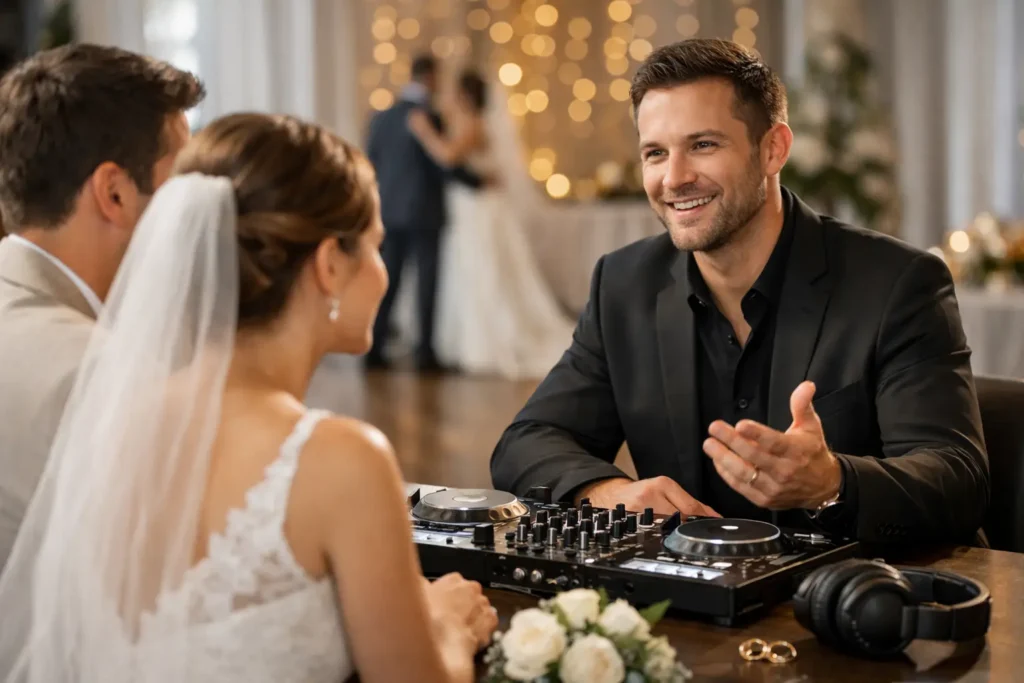
Chemistry counts. You don’t need your DJ to become your best friend, but you should feel comfortable with their communication style and confident in their presence. If they talk over you, brush off your concerns, or push a one-size-fits-all approach, believe that early impression.

On the other hand, if they ask smart questions, listen to your priorities, and offer ideas that fit your wedding instead of selling you every possible extra, that’s usually a strong sign. Good entertainment companies know that personalization is what guests remember.

This is especially true if your reception includes formalities, mixed family dynamics, or a packed timeline. You want someone who can be upbeat without becoming overbearing, organized without sounding robotic, and engaging without making the night feel like a scripted show.

At Electrified DJ Services, that balance is exactly what couples look for when they want high-energy entertainment with real planning support behind it.

The Best Choice Feels Personal and Professional

If you’re still wondering how to choose wedding DJ talent with confidence, keep it simple. Look for a company that understands weddings, not just music. Look for clear communication, proven crowd-reading ability, and a style that matches the celebration you actually want.

Your DJ helps set the tone for every major moment after guests arrive. When that role is handled well, the whole event feels easier, warmer, and more alive. Choose the team that makes you feel heard before the wedding, because that’s usually the team that will make your guests feel connected during it.

A great wedding doesn’t happen because every detail is perfect. It happens when the room feels right, the timing feels natural, and people don’t want the night to end.

Some wedding choices are easy. You taste the cake, you know. You see the dress, you feel it. But the dj versus band wedding question tends to stick around because both options can sound amazing on paper and feel very different in real life.

What matters most is not which one sounds more impressive to your guests before the wedding. It is which one actually keeps the room engaged, supports your timeline, and fits the kind of celebration you want from the first entrance to the last song. A great entertainment choice does more than play music. It shapes the pace of the night.

DJ versus band wedding: what really changes the night?

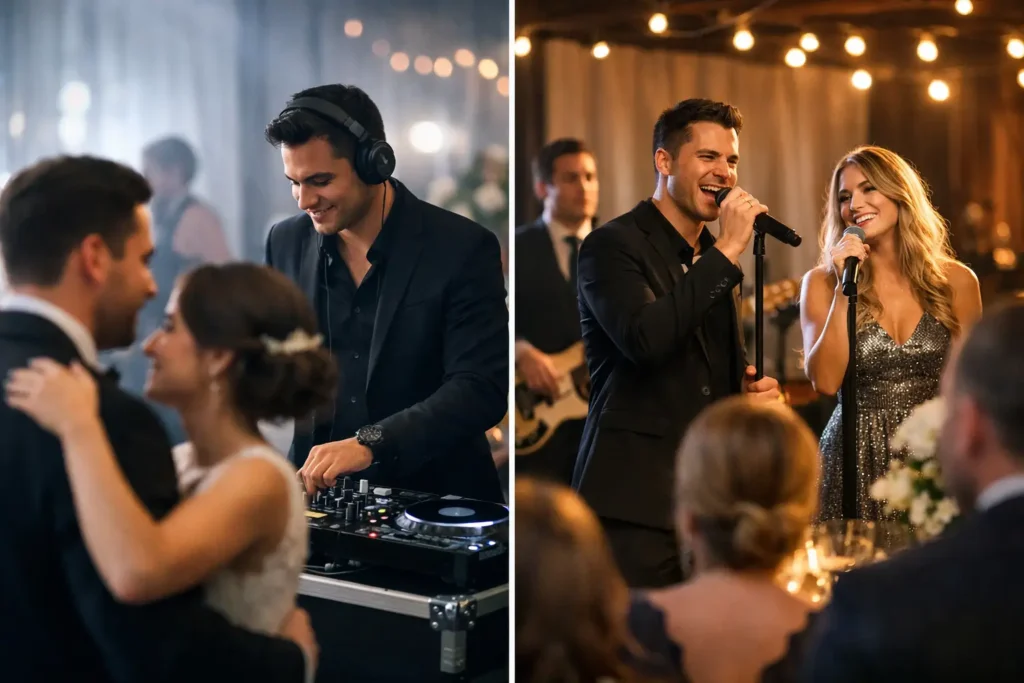
The biggest difference is control versus live presence. A live band brings a visual wow factor. There is something special about seeing musicians perform your first dance or a packed dance floor reacting to live vocals and instruments. If your wedding style leans formal, classic, or concert-like, a band can absolutely create a memorable atmosphere.

A DJ brings range, flexibility, and consistency across the entire event. That means cocktail hour can feel different from dinner, and dinner can transition naturally into a high-energy dance set without losing momentum. A skilled wedding DJ is not just pressing play. They are reading the room, adjusting in real time, coordinating with your planner and photographer, and keeping the flow tight.

That last part gets overlooked. At weddings, entertainment is not only about sound. It is also about timing. Your grand entrance, parent dances, cake cutting, and open dance floor all depend on smooth communication and pacing. The entertainment team often becomes the engine behind the night.

The budget conversation is real

For most couples, price matters. It should. Weddings come with enough decisions already, and entertainment has to fit the bigger picture.

In many cases, a band costs more than a DJ. You are paying for multiple performers, equipment, setup, and the logistics that come with a larger group. Some bands are worth every dollar, especially if live music is one of your top priorities. But if hiring a band means cutting corners on photography, lighting, or the overall guest experience, the trade-off may not feel worth it later.

A DJ usually gives you more flexibility in your entertainment budget. That can open the door for upgrades that guests really notice, like intelligent lighting, a photo booth, ceremony sound, bilingual MC support, or enhanced reception production. For couples who want one team managing multiple pieces of the event, that flexibility can make planning much easier.

This is often where the best answer shows up. It is not always band versus DJ in a vacuum. It is band versus DJ plus everything else you want the night to include.

Music variety matters more than most couples expect

A band has a signature style. That can be a huge plus if you love their sound and want your wedding to reflect it. But every band has limits. Their set list may be narrower than you expected, or certain songs may not hit the same live if your crowd wants the original version.

A DJ can move across decades, genres, and cultures quickly. That matters at weddings where the guest list includes grandparents, college friends, kids, coworkers, and extended family from different backgrounds. One room may need Motown, salsa, Top 40, freestyle, hip-hop, dance classics, and a few sing-alongs before the night is over.

For multicultural celebrations, that flexibility becomes even more important. If your wedding includes Latin music, bilingual announcements, or moments like Hora Loca, a DJ-led entertainment team can often pivot faster and keep the energy unified without awkward pauses or genre gaps.

That does not mean bands cannot handle variety. Some can. But if your priority is broad music coverage and rapid transitions, DJs usually have the advantage.

Space, volume, and venue logistics

This part is not glamorous, but it matters. Your venue can quietly decide whether a band or DJ makes more sense.

Bands need more room. They may need a larger stage area, more power access, extra setup time, and more load-in coordination. If your ballroom is spacious and the layout supports it, no problem. If your reception space is tighter, every extra piece of gear affects the room.

Volume is another issue. Live bands can be powerful, but they are not always as easy to scale for the room. At some weddings, especially those with older guests or a venue that already has sound restrictions, that can create challenges during dinner and speeches.

A professional DJ setup is usually easier to tailor. The volume can be adjusted more precisely, the footprint is smaller, and the transitions between formal moments and dance sets are smoother. If your venue has strict timing or noise expectations, a DJ is often the simpler fit.

Who keeps the wedding moving?

This is where couples should think beyond music. Someone needs to guide the event.

A wedding DJ often doubles as MC or works alongside one. That means introductions, cueing key moments, getting guests where they need to be, coordinating with the photographer, and helping the night stay on track without sounding stiff or overproduced. A strong DJ and MC team keeps things lively while protecting the timeline.

A band may have a front person who can make announcements, but that role is not always as detailed or event-focused. Some bands are excellent at performance and less focused on the nuts and bolts of reception management. That is not a flaw. It is just a different strength.

If your wedding is packed with moving parts, the ability to combine music control, MC leadership, and vendor coordination can be a major advantage.

Guest energy is not one-size-fits-all

Some crowds love the spectacle of a live band. They respond to the musicians, the stage presence, and the feeling of a live show. If your guest list skews toward people who love concerts, classic wedding traditions, or upscale black-tie energy, a band may feel like the perfect match.

Other crowds want nonstop familiarity. They want the songs they know, the versions they recognize instantly, and the ability to go from one era to the next without missing a beat. That is where DJs tend to shine. A great DJ can build momentum with precision, then change course fast if the room shifts.

That room-reading skill is a bigger deal than many people realize. Weddings are mixed crowds by definition. The plan you imagine at 11 a.m. might not be what your guests want at 9:30 p.m. The entertainment team has to react, not just perform.

The hybrid option is worth considering

Some couples do not want to choose one or the other. That is valid.

A hybrid setup can work beautifully, especially if you want live music for ceremony or cocktail hour and a DJ for the reception. You get the elegance of live performance early in the event, then the flexibility and dance-floor control of a DJ once the party starts.

This approach can also make sense if you want a featured musician, like a sax player, percussionist, or vocalist, without committing to a full band all night. It adds live energy while keeping the music range wide and the pacing tight.

For couples who want a celebration that feels elevated but still practical, hybrid entertainment often hits the sweet spot.

So which one is right for your wedding?

If your top priorities are live performance, visual impact, and a specific musical style, a band may be the right choice. If your top priorities are versatility, room-reading, timeline control, and value across the full event experience, a DJ is often the better fit.

For many weddings, especially those with mixed-age guests, diverse music tastes, and a lot of moving parts, the smartest answer is the option that gives you the most control without draining your budget. That is why so many couples land on a professional DJ team. You are not just hiring music. You are hiring momentum, coordination, and the ability to keep guests engaged from start to finish.

At Electrified DJ Services, that is how we look at entertainment. Not as background noise, but as one of the biggest reasons a wedding feels smooth, exciting, and unforgettable.

The best choice is the one that fits your people, your space, and your vision when the room is full and the night is actually happening. If you can picture your guests smiling, singing, and staying on that dance floor longer than planned, you are probably getting close.

The fastest way to turn a beautiful wedding into a long night is getting the entertainment wrong. Guests will forgive a slow dinner service. They will not forget a silent dance floor, awkward transitions, or a timeline that feels like nobody is steering the ship. That is exactly why a solid wedding entertainment planning guide matters. Entertainment is not just the party at the end. It shapes the mood, controls the pace, and helps your whole celebration feel alive.

Some couples start planning with a simple idea – book a DJ and call it done. Sometimes that works. More often, though, the best weddings are built around a bigger entertainment plan. Music, MC direction, lighting, special moments, guest interaction, and media coverage all work together. When those pieces are aligned, your wedding feels easy for you and exciting for everyone else.

What a wedding entertainment planning guide should actually cover

A real wedding entertainment planning guide should go beyond song lists. Your entertainment team affects how guests enter the room, how introductions land, when energy builds, and whether the night flows naturally or feels choppy. That means planning has to start with the full guest experience, not just the dance set.

Begin with your crowd. A wedding with mostly college friends will move differently than one with a large family guest list, young kids, and grandparents at every table. A multicultural wedding might need bilingual MC support, mixed music formats, or traditions that deserve their own spotlight. A couple hosting a formal ballroom wedding may want polished pacing and elegant lighting, while a backyard-style celebration may need more relaxed crowd interaction and looser transitions. None of these options is better. They just require different choices.

Your venue also matters more than people think. A grand space can handle uplighting, a larger sound setup, and visual extras without feeling crowded. A smaller room may need tighter production choices so the entertainment adds energy without overwhelming the space. That balance is where experience shows.

Start with the timeline, not the playlist

Most couples naturally think about music first, but timeline should come first. If you do not know how the night is structured, it is hard to know what kind of entertainment support you actually need.

Ceremony, cocktail hour, grand entrance, first dance, parent dances, toasts, dinner, cake cutting, and open dancing all create different energy levels. Your DJ and MC are not just filling gaps between those moments. They are helping each one land at the right time and with the right tone.

This is where couples often underestimate the value of a strong MC. A great MC keeps the event moving without sounding forced or cheesy. They can guide guests, coordinate with the venue and photographer, and keep everyone informed without pulling attention away from the couple. That may not sound flashy during planning, but on wedding day, it can be the difference between smooth and stressful.

If you are adding cultural traditions, surprise performances, a Hora Loca set, or interactive experiences, those should be built into the schedule early. Trying to squeeze them in later usually creates rushed transitions or cuts into dancing time.

The DJ does more than play music

When couples choose entertainment, they often compare prices before they compare performance style. That is understandable, but it can be expensive in the wrong way. The cheapest option may save money upfront and cost you the atmosphere you wanted.

A wedding DJ should know how to read a room, not just hit play on a playlist. That means knowing when to keep a song going, when to switch genres, when to bring back older guests, and when to lean into the energy your friends are creating. A packed dance floor is rarely random. It is built in real time.

Customization matters too. Your wedding should not sound like a copy of the last five weddings your guests attended. That does not mean every song has to be obscure or deeply personal. It means your entertainment should reflect your taste, your families, and your version of fun. For some couples, that means club-style energy. For others, it means singalongs, Latin favorites, throwbacks, or a balanced mix that keeps every generation included.

Lighting changes the room faster than decor

Couples tend to spend a lot of time on centerpieces and signage, then treat lighting like an extra. In reality, lighting is one of the fastest ways to change how your wedding feels.

Soft uplighting can make a ballroom look warmer and more polished. Intelligent dance lighting can turn an open floor into a real party zone. Monograms and accent lighting can personalize the room without adding clutter. If you want a reception that feels elevated before dancing even starts, lighting deserves a place in the conversation.

That said, more is not always better. Some weddings need dramatic effects. Others benefit from a cleaner look with subtle enhancement. The right choice depends on your venue, your guest count, and whether your style leans elegant, high-energy, or somewhere in between.

Interactive extras should match your guests

Photo booths, 360 booths, live social sharing, and special performance add-ons can absolutely boost the experience. They can also become expensive distractions if they are chosen just because they look fun online.

The best add-ons support the way your guests like to celebrate. A digital booth works well when guests want instant keepsakes and social-ready content. A 360 booth can be a huge hit with outgoing crowds and younger guests who want a high-energy interactive moment. Live streaming can be especially meaningful when family members cannot attend in person. Photography and videography become even more valuable when they are coordinated with the entertainment timeline instead of operating in a separate lane.

The key is fit. If your reception is already packed with speeches, dances, traditions, and a short event window, too many extras can compete for attention. If you have a longer reception and a guest list that loves to move, mingle, and create memories, those enhancements can add a lot.

One team or multiple vendors?

This is one of the biggest practical decisions in any wedding entertainment planning guide. You can hire separate vendors for DJ, MC, lighting, photo booth, photography, videography, and streaming. Plenty of couples do. But every added vendor creates another conversation, another contract, another arrival time, and another chance for miscommunication.

There is a real advantage to working with one entertainment-focused team that can coordinate major event elements together. The music team knows when the photographer needs you. The photo booth timing does not clash with key dance moments. The lighting setup supports both the room design and the dance floor energy. It is simpler for you, and it usually feels more cohesive to your guests.

This is especially helpful for couples who are busy, planning from a distance, or balancing input from multiple family members. Convenience is not just about saving time. It is about reducing wedding-day friction.

Questions worth asking before you book

Not every vendor who offers entertainment is built for weddings. Weddings require crowd management, flexibility, timing, and the ability to work with other professionals under pressure. Before booking, ask how they handle timeline changes, guest requests, announcements, and mixed-age dance floors. Ask whether they have experience with bilingual events or cultural traditions if that matters to your celebration.

You should also ask how planning works. Do they help shape the flow of the reception, or do they wait for you to provide every detail? Do they build around your must-play and do-not-play preferences? Can they offer multiple services under one roof without sacrificing quality? Those answers tell you a lot about what your experience will be like.

For couples in Northern New Jersey, local familiarity can help too. A team that knows the venues, pacing expectations, and guest energy of the area often has an easier time adjusting in the moment.

Build around the feeling you want

The most successful weddings do not all look the same, but they usually have one thing in common. They know what feeling they are trying to create.

Maybe you want elegant and polished early, then full celebration later. Maybe you want nonstop energy from the first entrance. Maybe you want your families, cultures, and personalities to feel equally represented all night long. Once you define that feeling, entertainment decisions become clearer. You stop choosing random features and start building a guest experience.

That is the real point of planning. Not just checking off services, but creating a wedding that feels personal, well-run, and unforgettable for the right reasons.

If you are weighing your options, trust the pieces that affect the room in real time. Music, flow, lighting, and guest interaction are the parts people feel, even when they cannot explain why. Get those right, and the whole celebration has a better chance of feeling exactly the way you imagined.

Price tags on wedding DJ packages can look similar at first glance, then feel wildly different once you start asking what is actually included. One package covers ceremony audio and cocktail hour. Another adds an MC, uplighting, and a photo booth. A third looks cheaper until you realize basic planning support, extra hours, and backup equipment are all separate line items. That is where couples can get stuck.

The right package is not just about music. It is about how your day moves, how your guests feel, and how much you want one team handling the entertainment side of the celebration. If you want a packed dance floor and a smooth timeline, it helps to know what you are really buying.

What wedding DJ packages should include

At a minimum, a strong wedding package should cover professional DJ performance, quality sound equipment, setup and breakdown, and planning support before the event. That sounds basic, but there is a big difference between someone who simply shows up with speakers and someone who helps shape the flow of the night.

A wedding DJ is often doing two jobs at once. They are managing music and acting as part of the event team. That means coordinating entrances, keeping formalities on schedule, cueing special songs, making announcements clearly, and adjusting the energy in real time. If a package includes MC services, that matters. If it does not, ask who is directing the reception.

Ceremony coverage is another area couples should check closely. Some packages include a separate sound setup for the ceremony and wireless microphones for vows or readings. Others only cover the reception. If your ceremony, cocktail hour, and reception happen in different spaces, make sure the package reflects that reality.

The difference between basic and full-service packages

A basic package usually works for couples who want straightforward reception coverage with solid music and simple announcements. If your venue has a built-in coordinator, your timeline is short, and you are not interested in extra production, that may be enough.

A full-service package is built for couples who want a more complete entertainment experience and less vendor juggling. That often includes ceremony sound, cocktail hour music, reception DJ and MC services, intelligent lighting, planning meetings, and optional upgrades like photo booths, photography, videography, or live social sharing.

That difference matters because weddings rarely feel simple once the day starts moving. The more elements you want coordinated, the more value there is in booking a team that already works together. One trusted company handling music, announcements, lighting, and guest-facing entertainment can remove a lot of stress.

For many couples, convenience is not a luxury add-on. It is a practical way to avoid miscommunication and protect the guest experience.

How to compare wedding DJ packages without getting fooled by price

The lowest number on a quote does not always mean the best deal. It usually means you need to ask better questions.

Start with hours of coverage. Some packages are based on a fixed block of time, while others build in more flexibility. If your reception runs long or your venue timeline shifts, overtime rates can change the total quickly. It is worth asking what happens if the event extends by thirty minutes or an hour.

Then ask about staffing. Is there one DJ doing everything, or a DJ and MC working together? For larger weddings, bilingual events, or high-energy receptions with a lot of formalities, having dedicated roles can make the night feel much more polished.

Equipment is another key factor. Professional wedding DJ packages should include reliable gear and backups. Not because couples love talking about cables and speakers, but because reliability is part of what you are paying for. If a company has backup equipment and a real process behind its events, that is a good sign.

Planning support should also be part of the comparison. Some vendors provide music worksheets, timeline guidance, and direct communication leading up to the wedding. Others take a more hands-off approach. Neither model is automatically wrong, but if you want help shaping the flow of the evening, make sure that support is built in.

Add-ons that are actually worth it

Not every upgrade belongs in every wedding. Some are worth every penny. Some are only useful if they fit your crowd, venue, and priorities.

Lighting is often more valuable than couples expect. Uplighting can change the look of a ballroom, warm up a modern space, and make the room feel finished in photos and video. Dance floor lighting adds energy later in the night, especially once formalities are over and the party takes over.

Photo booths tend to be a smart add-on when you want entertainment beyond dancing. They give guests something interactive to do during cocktail hour or open dancing, and they work especially well for mixed-age crowds. Digital booths and 360 booths create a different kind of momentum than a traditional print setup, so the best choice depends on the vibe you want.

Bundled photography and videography can also be a strong move if you want one team working from the same timeline. The benefit is not just convenience. It is coordination. When entertainment and media teams are aligned, moments tend to feel less rushed and more intentional.

For multicultural weddings, bilingual MC services or specialty segments like Hora Loca can be more than an add-on. They can be central to making the celebration feel authentic to your families and guests. If that is part of your vision, it should be discussed from the beginning, not added as an afterthought.

What package fits your wedding style?

If you are planning a smaller wedding with a relaxed timeline, you may not need the biggest package on the menu. A focused setup with ceremony audio, reception DJ service, and clean MC support might be perfect. The goal is not to buy more than you need. The goal is to get the right coverage.

If your guest list is large, your reception is formal, or your crowd loves to dance, a more complete package usually pays off. More planning support, stronger production, and a team approach create a better experience when the room is busy and the schedule matters.

If your wedding includes multiple cultures, languages, or generations with different music expectations, customization becomes even more important. A DJ should be able to blend styles, read the room, and keep everyone feeling included instead of splitting the night into disconnected parts.

This is where local experience helps too. A company that knows the rhythm of New Jersey weddings, venue logistics, and the expectations of diverse family celebrations can make the process feel a lot easier. Electrified DJ Services builds around that all-in-one model because couples want the fun part to feel effortless, not patched together.

Questions to ask before you book

Before you sign any contract, ask what is included, what is optional, and what happens on the day if something changes. Ask who your main point of contact will be. Ask how music requests are handled, how the timeline is built, and whether the DJ takes a hands-on approach with crowd interaction or a more reserved one.

You should also ask how personalized the event will feel. Some wedding DJ packages are essentially plug-and-play. Others are built around your must-play songs, your do-not-play list, your family traditions, and the kind of energy you want at each stage of the night.

That last part matters more than couples sometimes realize. A great wedding DJ does not just play hits. They manage transitions, protect momentum, and know when to shift gears. That is what turns a nice reception into a night people keep talking about.

The best package is the one that supports the whole experience

Couples sometimes shop for DJ services as if they are buying speakers and a playlist. In reality, they are choosing the pace, personality, and pressure level of a huge part of the wedding day.

The strongest wedding DJ packages are the ones that match your timeline, your guest mix, and your priorities. If you want simple, keep it simple. If you want one team to handle the soundtrack, the announcements, the lighting, and the guest engagement, choose a package that is built for that from the start.

A successful event depends on the quality of your entertainment, but it also depends on planning, communication, and execution. When those pieces are working together, the music feels better, the room feels easier, and your guests feel it too.

Choose the package that lets you enjoy your wedding instead of managing it. That is usually the smartest investment of all.

Wedding planning gets complicated fast when your DJ, photo booth, lighting team, videographer, and MC all work separately. An all in one wedding entertainment package cuts through that mess by putting the energy, timing, and guest experience under one roof. For couples who want a packed dance floor without spending months managing vendors, that kind of setup can make the whole day feel more organized and a lot more fun.

Why an all in one wedding entertainment package works

The biggest advantage is not just convenience. It is coordination.

When entertainment and media services are booked through one team, your grand entrance, first dance, speeches, lighting cues, photo booth traffic, and reception flow are planned together instead of stitched together by different companies. That matters on a wedding day. The best moments do not happen because everyone showed up with good equipment. They happen because the timing is right, the room feels connected, and the team knows what is happening next.

A strong all in one wedding entertainment package usually brings the DJ and MC together with enhancements that shape the atmosphere. That might include intelligent lighting, uplighting, digital photo booths, 360 booths, photography, videography, live streaming, and bilingual hosting. The point is not to add services for the sake of it. The point is to create one experience that feels polished from the ceremony through the last song.

For many couples, that also means fewer emails, fewer contracts, and fewer chances for miscommunication. Instead of explaining your timeline five different times, you have one team that already understands the full picture.

What should be included in an all in one wedding entertainment package?

Not every package is built the same, and that is where couples need to pay attention. Some companies use the phrase loosely and really mean DJ plus one add-on. Others offer a true event production setup.

At a minimum, a quality package should include professional DJ service, experienced MC support, sound for key moments, and planning around the reception timeline. From there, the most valuable add-ons are usually lighting and visual memory services.

Lighting changes a room faster than almost anything else. A ballroom with clean uplighting and smart dance floor effects feels intentional. It looks better in photos, feels more energetic for guests, and helps transition the room from dinner to dancing without awkward dead space.

Photo booths also earn their place when they are handled well. A digital booth can keep guests engaged during cocktail hour or while the couple is taking formal photos. A 360 booth adds more of a statement piece and works best when the guest list wants a high-energy interactive feature. Neither one replaces a great photographer, but both can add a layer of guest participation that keeps the reception moving.

Photography and videography are where the all-in-one model can really stand out. When your entertainment and media team work together, they are not competing for position during introductions or major dances. They already know the timeline, the lighting plan, and where the action will happen.

The real difference between bundled and coordinated

Here is the part couples often miss. A package is only valuable if it is coordinated well.

You can book five services from one company and still end up with a disconnected event if the DJ does not communicate with the photographer, or if the MC feels generic, or if the lighting is treated like an afterthought. The best all in one wedding entertainment package is not just a bundle discount. It is a system.

That system should include pre-event planning, clear communication, music customization, and someone who can read the room in real time. Weddings are live events. Timelines shift. Toasts run long. The dance floor starts slow and then suddenly breaks open. A team that performs weddings regularly knows how to adjust without making guests feel the change.

That is especially important for multicultural weddings, bilingual households, and mixed-age guest lists. A playlist alone does not solve that. You need an MC and DJ who understand how to speak to the room, shift energy, pronounce names correctly, and respect the tone of each part of the celebration.

When this type of package makes the most sense

An all in one wedding entertainment package is a smart fit for couples who care about experience and efficiency. If you are planning a large reception, working on a tight timeline, or simply do not want to manage multiple vendors, it can save time and reduce stress.

It is also a strong option when the reception has a lot of moving parts. Maybe you are planning a ceremony on site, cocktail hour in a separate space, formal entrances, special dances, a packed dance set, and a late-night party atmosphere. The more transitions your wedding has, the more valuable it becomes to have one team handling the sound, pacing, and crowd engagement.

For couples in Northern New Jersey, there is another layer to this. Local experience matters. A team that knows the venue styles, banquet flow, guest expectations, and timing realities of weddings in this market can often prevent problems before they start.

What to ask before booking

Before you commit, ask how the package actually works on event day.

Who is your main point of contact? Is the MC separate from the DJ, or is one person doing both? Are lighting and booth attendants included? Will the photography and videography teams coordinate with the entertainment timeline? How much of the music is customized, and how much is preset?

You should also ask about setup timing, backup equipment, and how the company handles changes. If your ceremony runs late or your family wants to add a special cultural moment, you want a team that can adapt without losing control of the event.

This is also the right time to ask about personality. A wedding vendor can have all the gear in the world and still be the wrong fit if they feel stiff, distracted, or overly scripted. The right entertainment team should feel confident, organized, and easy to work with. They should sound like people who know how to lead a room without taking over your wedding.

The trade-offs to think through

This approach is not automatically right for every couple. If you already have a photographer you love, a family friend doing live music, or a venue that includes in-house lighting, a full package may overlap with what you already have.

There is also the question of specialization. Some couples prefer to book individual vendors because they want a very specific artistic style for film or photography. That can be the right move if those priorities are central to your vision. The trade-off is that you will need to manage more coordination yourself, or rely heavily on a planner to do it.

For most couples, though, the sweet spot is finding a company that offers flexible packaging instead of forcing an oversized bundle. You want the simplicity of one trusted team without paying for features you do not need.

A better guest experience from start to finish

Guests may never use the phrase all in one wedding entertainment package, but they absolutely feel the results when it is done right.

They feel it when the ceremony audio is clear. They feel it when introductions are exciting instead of awkward. They feel it when the lighting shifts at the perfect moment, when the booth is active but not chaotic, and when the dance floor stays full because the DJ is reading the room instead of playing for themselves.

That is the difference between checking boxes and creating momentum.

A company like Electrified DJ Services is built around that kind of momentum, combining entertainment, media, lighting, and guest interaction into one coordinated experience. For couples who want one team to manage the energy and the memories, that model makes a lot of sense.

Your wedding does not need more moving parts. It needs the right ones, handled by people who know how to bring them together. If a package gives you that kind of control, personality, and peace of mind, it is worth a serious look.

Some of the most emotional moments at an event happen in front of people who could not make it into the room. A grandmother watching a first dance from another state. A college friend catching the grand entrance between meetings. A relative overseas hearing vows in real time instead of the next day in a shaky phone clip. That is why live social media streaming events have become more than a nice extra. For many weddings and private celebrations, they are part of the guest experience.

When live streaming is done well, it does not pull attention away from the room. It supports it. The in-person crowd still gets the music, the energy, the lighting, and the shared reactions. Remote guests get a clear, intentional window into the celebration instead of a random social post or a poor-quality video from the back of the room. The difference is planning.

Why live social media streaming events matter at real celebrations

Events are more connected than ever, but that does not mean every guest can physically attend. Travel costs, health concerns, work schedules, military service, childcare, and distance all affect who can be there. Couples and families feel that gap, especially when the missing guests are people who matter most.

A strong stream closes that gap without changing the heart of the event. Guests at home can still witness the ceremony, speeches, special dances, or major reveal moments as they happen. That matters emotionally, but it also matters practically. Instead of answering follow-up texts all night or collecting clips from ten different phones, the hosts know key moments are being shared clearly and professionally.

For weddings, streaming is especially valuable because the day moves fast. Once the ceremony starts, there is no replay for the people who missed it. For sweet 16s, anniversaries, school functions, and milestone birthdays, the same idea applies. If the moment is worth producing in the room, it is worth sharing properly with the people who cannot be there.

What makes live social media streaming events successful

The best streams feel easy to the viewer because a lot of work happened before the camera went live. Success usually comes down to three things: clear priorities, reliable production, and a team that understands live events.

Start with the moments that matter most

Not every part of an event needs to be streamed. In fact, trying to broadcast everything can make the final result weaker. A ceremony, grand entrance, candle lighting, first dance, speeches, or Hora Loca segment may deserve coverage. Cocktail hour small talk probably does not.

The right plan depends on the event and on the audience. Some couples want a private ceremony stream for family members who cannot travel. Others want a more energetic social broadcast that captures the entrance, packed dance floor, and crowd reactions. There is no one-size-fits-all answer, and that is a good thing. A personalized stream always feels more intentional than a generic all-day feed.

Good audio matters more than most people expect

People will forgive a slightly imperfect camera angle. They will not stay on a stream with bad sound. If viewers cannot hear vows, speeches, or introductions clearly, the emotional impact disappears fast.

That is why streaming at events is not just about pointing a phone toward the action. Music volume, microphone levels, room acoustics, and crowd noise all have to be managed. A team that already understands DJ sound, MC timing, and event flow has a real advantage here because they know when audio needs to shift and how to keep important moments intelligible.

The stream should work with the event, not against it

This is where experience shows. A wedding is not a studio shoot. People are moving, crying, hugging, dancing, and reacting in real time. The entertainment timeline changes. The room energy changes. Sometimes the best moment of the night is not on the original schedule.

A strong streaming setup has to stay flexible without becoming chaotic. That means knowing where cameras can go without blocking guests, when to stay wide, when to get closer, and how to avoid turning a celebration into a production set. The event should still feel natural in person.

Live social media streaming events are not the same as a guest going live

This is one of the biggest misconceptions. Plenty of hosts assume a friend can just stream from a phone and call it done. Technically, yes, someone can go live. But there is a huge difference between going live and creating a stream people actually want to watch.

A guest filming casually is usually reacting to the moment for themselves. They might turn the phone vertically one minute and sideways the next. They may block the lens, lose signal, miss the key shot, or talk over the ceremony. None of that is malicious. They are guests first.

Professional streaming is different because the priority is the viewing experience and the event itself. The camera placement is intentional. The sound is considered. The stream is timed with the actual flow of the day. That protects the quality of what remote guests see, and it also protects the hosts from having to manage another moving part while trying to enjoy their event.

When streaming adds the most value

Some celebrations benefit from streaming more than others. Weddings are the obvious example, especially when families are spread across states or countries. It is also a smart addition for multicultural celebrations where not every loved one can travel, or for bilingual families who want distant relatives to feel included in a meaningful way.

Private parties can benefit too, particularly milestone birthdays, anniversaries, and retirement celebrations where the guest list may span generations. School events, proms, and community celebrations sometimes use streaming to extend the experience beyond the venue while still keeping the focus on the people in the room.

That said, not every event needs a live broadcast. If the hosts want a very intimate atmosphere or the venue has serious connectivity limitations, a recorded video option may make more sense. The right answer depends on the goal. Streaming works best when it serves the event instead of being added just because it sounds modern.

How to plan live social media streaming events the smart way

The easiest mistake is treating streaming like an afterthought. If it gets discussed too late, the result is usually compromised camera placement, unclear audio, and rushed coordination with the entertainment timeline.

It is better to decide early what remote guests need to see. Is the stream centered on the ceremony? Is it about the party energy? Is it for a private group, or is it meant for a broader social audience? Those choices affect setup, staffing, and the way the event is paced.

This is also where an all-in-one event team makes life easier. When the DJ, MC, lighting, and media coverage are coordinated under one roof, fewer things get lost in translation. The stream team knows when the introductions are happening. The MC understands what remote viewers should be able to hear. The DJ can help shape audio so that it plays well both in the room and on the broadcast. That kind of coordination removes stress for the host because there are fewer vendors trying to guess each other’s timing.

For couples and families planning in Union, Roselle, and nearby North Jersey communities, that local familiarity can make a real difference. Every venue has its own layout, signal challenges, and timing quirks. A team that knows how local events actually run is better equipped to keep things smooth when the schedule shifts or the room gets lively.

What guests remember after the stream ends

People do not remember streaming because the resolution was impressive or because the setup looked technical. They remember it because they felt included. They saw the hug, heard the speech, caught the laugh, and felt like they were part of a moment they would have otherwise missed.

That is the real value. Live streaming is not there to replace being in the room. Nothing can do that. It is there to widen the circle without weakening the experience for the guests who showed up in person.

At its best, a live stream becomes part of the event’s hospitality. It says, we thought about the people who could not make it, and we made space for them too. That kind of planning always feels generous, and guests notice.

If you are already putting energy into the music, the timeline, the atmosphere, and the memories, it makes sense to give remote guests more than a shaky phone video. Give them a real seat at the celebration.

The difference between a wedding that feels effortless and one that feels awkward usually comes down to timing, tone, and transitions. That is exactly where mc services for weddings make a real impact. A great MC does much more than speak into a microphone – they guide the flow, energize the room, keep vendors aligned, and help every big moment land the way it should.

Most couples spend a lot of time thinking about the music, the food, the flowers, and the photos. All of that matters. But if nobody is confidently steering the event from one moment to the next, even a beautiful wedding can start to feel disjointed. Guests do not always know where to go, when to gather, or what is happening next. That confusion can slow the energy of the night fast.

What MC services for weddings actually include

A wedding MC is part host, part coordinator, and part crowd leader. The job is not just making announcements. It is reading the room, keeping the timeline on track, and making sure your guests feel included instead of herded.

At the reception, an MC may introduce the wedding party, welcome guests, cue the first dance, guide attention to speeches, announce dinner service, set up special dances, and transition the room into open dancing. They are also often the person communicating quietly with the DJ, photographer, videographer, venue staff, and planner so that key moments happen at the right time.

That behind-the-scenes role matters more than many couples realize. If the toast starts before the photographer is ready, or if guests are still at the bar when the cake cutting begins, the moment loses impact. A polished MC helps prevent that.

Why the right MC changes the entire reception

A wedding is emotional, fast-moving, and full of moving parts. The right MC brings structure without making the event feel scripted. That balance is where experience shows.

A strong MC knows when to be high energy and when to step back. Grand entrances, packed dance floors, and interactive crowd moments call for confidence and excitement. Formal dances, parent tributes, and heartfelt toasts need a softer touch. The best MCs know that not every moment should be loud. They understand pacing.

This is also why hiring someone who only has a good speaking voice is not the same as hiring a real wedding MC. Weddings are live events. Things shift. Dinner runs late. A family member disappears right before introductions. A toast goes long. A good MC adjusts in real time without making guests feel the pressure.

The MC and DJ should work as one team

One of the biggest advantages of booking DJ and MC support together is chemistry. When the DJ and MC already know how to work together, your event feels tighter, smoother, and more natural.

The MC can cue the room while the DJ builds the right music underneath the moment. The DJ can read how guests are responding while the MC keeps attention focused where it needs to be. That partnership is a major reason some receptions feel electric and others feel flat, even when they have similar playlists.

For couples planning a wedding, this matters because entertainment is not just about songs. It is about momentum. If the room loses energy between formalities, it takes real skill to build it back up. An experienced MC and DJ team knows how to protect that momentum all night.

Not every wedding needs the same MC style

This is where personalization matters. Some couples want an elegant, understated host who keeps things classy and polished. Others want a lively, interactive personality who gets guests shouting, clapping, and rushing to the dance floor. Neither approach is automatically better. It depends on your crowd, your culture, and the kind of celebration you want.

A formal ballroom wedding may call for a more refined delivery. A high-energy multicultural reception might need an MC who can switch gears quickly, speak to different generations, and keep the atmosphere vibrant. If your guest list includes bilingual family and friends, having someone who can communicate naturally in both English and Spanish can make guests feel seen instead of sidelined.

That is not a small detail. Inclusive entertainment changes the experience for everyone in the room.

What to look for when comparing MC services for weddings

The best fit is not always the loudest personality or the cheapest package. Couples should look at how the MC contributes to the full experience.

First, pay attention to planning. A solid MC wants to know your names, pronunciation, family dynamics, timeline, traditions, and must-hit moments. If they are not asking questions before the wedding, that is a red flag. Great event flow starts long before the reception begins.

Second, ask how they handle coordination. Your MC should be able to work smoothly with planners, photographers, venues, and entertainment staff. Weddings move quickly, and a lot of your guest experience depends on vendors acting in sync.

Third, ask about flexibility. The timeline on paper is one thing. The timeline on the wedding day is often another. You want someone who can adapt without sounding flustered or forcing the event into a rigid script.

Finally, think about personality match. You do not need a comedian if that is not your style. You do need someone who sounds comfortable, confident, and genuinely invested in making your wedding feel like yours.

Common mistakes couples make with wedding MCs

One common mistake is assuming a venue coordinator will cover the same role. Coordinators are essential, but they usually focus on logistics, vendor timing, and venue operations. They are not typically engaging the crowd, setting the tone, or driving reception energy.

Another mistake is treating the MC as an afterthought because the DJ seems like the bigger priority. In reality, the two roles are deeply connected. A talented DJ can keep people dancing, but the MC often determines whether the room gets to those dance moments smoothly in the first place.

Some couples also worry that having an MC means the event will feel too pushy or overproduced. That can happen if the style is wrong for the wedding. But the answer is not skipping MC support altogether. It is choosing someone who understands restraint, timing, and when to let the moment breathe.

How MC services help reduce wedding stress

A lot of wedding stress comes from not wanting to manage people on your own day. You should not be the one rounding up guests for entrances or checking whether the best man is ready for his toast. Your family should not have to do it either.

When your MC is experienced, those responsibilities shift off your plate. Someone is actively watching the timeline, cueing the next moment, and helping the room stay connected to what is happening. That creates a better guest experience, but it also gives you more freedom to enjoy your own celebration.

This is especially valuable for larger weddings, multicultural receptions, and events with several moving parts like photo booths, special performances, or late-night dance sets. The more layers your event has, the more useful a skilled MC becomes.

A strong MC protects the moments you will remember

Years from now, you probably will not remember every timeline adjustment that happened behind the scenes. You will remember how your entrance felt, whether your first dance had the room with you, whether your parents felt honored, and whether the dance floor stayed alive.

That is what good MC work supports. It keeps meaningful moments from getting lost in the chaos. It gives your reception shape, rhythm, and personality.

For couples who want one trusted team to manage entertainment with confidence, that support can make planning feel a lot easier. Companies like Electrified DJ Services build around exactly that idea – high energy when the room needs it, polished coordination when timing matters, and a wedding experience that feels custom instead of cookie-cutter.

If you are choosing entertainment right now, do not just ask who is bringing the music. Ask who is guiding the night. The right MC is often the reason your wedding feels less like a series of scheduled events and more like one unforgettable celebration.

Your guests may not remember every centerpiece or signature drink, but they will remember how your wedding felt. That feeling starts with custom wedding music planning – not just picking songs you like, but building the soundtrack for a day that needs to move, breathe, and hit the right emotional note at the right time.

That is where many couples get stuck. They know they want a packed dance floor, a meaningful ceremony, and smooth transitions, but they are staring at endless playlists with no clear plan. Great wedding music is not random. It is curated around your relationship, your crowd, your timeline, and the kind of energy you want people talking about on the ride home.

Why custom wedding music planning matters

A wedding has different phases, and each one asks for something different from the music. The pre-ceremony needs warmth without distraction. The processional needs timing. Cocktail hour should feel social and polished. Dinner should support conversation. Then the dance floor needs a smart ramp-up, not a cold start.

If all of that gets treated like one big playlist, the event can feel disconnected. You might have songs you love, but the flow can still fall flat. Custom planning fixes that by matching the right music to the right moment instead of hoping one style works for every part of the night.

It also helps avoid the classic mismatch between couple and crowd. Maybe you love indie folk, but your families want Motown, salsa, Top 40, and a few wedding singalongs. That does not mean your taste gets pushed aside. It means the plan needs range. The strongest wedding soundtrack reflects the couple while still reading the room and keeping guests engaged.

What custom wedding music planning really includes

This goes far beyond a must-play list. A real plan starts with the key formalities – ceremony songs, grand entrance music, first dance, parent dances, cake cutting, and last song. Those selections matter because they anchor the day’s emotional highlights.

Then comes the larger picture. What should guests hear as they arrive? Do you want cocktail hour to feel romantic, modern, upbeat, or culturally specific? Should dinner lean elegant and understated, or should it already start building momentum? These choices shape the experience even when people are not fully aware of it.

The dance floor strategy matters just as much. A strong DJ does not simply line up bangers and press play. They plan around age ranges, family dynamics, cultural traditions, and the pacing of the reception. A room full of college friends responds differently than a wedding with three generations, bilingual guests, and a big mix of music backgrounds.

That is also where do-not-play selections come in. They are just as useful as favorites. If there are songs you are tired of, genres you never want to hear, or lyrics that do not fit your event, saying that upfront protects the vibe. Custom planning is not only about what gets added. It is also about what gets filtered out.

Start with the mood, not just the songs

One of the easiest ways to make music planning less stressful is to stop thinking song-first. Start by describing the feeling you want in each part of the day.

For example, your ceremony might be intimate and timeless. Cocktail hour could be stylish and upbeat. Dinner might feel warm and celebratory. The dance floor might need to start broad, then turn high-energy later in the night. Once those moods are clear, song choices become easier because every selection has a job.

This approach is especially helpful for couples with wide-ranging tastes. You may both love completely different genres, and that is fine. The question is not which genre wins. The question is where each style fits best. A jazz-forward cocktail hour and a high-energy open dance set can both belong in the same wedding if they are placed with intention.

How to balance your taste with guest energy

This is where experience matters. A wedding is personal, but it is also a live event. The music should reflect you without ignoring the reality of the room.

Sometimes couples worry that accommodating guests will make the night feel generic. It does not have to. The key is choosing the right moments for personal favorites and the right moments for broad crowd appeal. Your processional, first dance, and private last dance can be deeply personal. Your dance floor can still include the songs that get your family and friends out of their seats.

There is always some trade-off. If your playlist is too niche, guests may disengage. If it is too crowd-driven with no personality, the wedding can feel interchangeable. The sweet spot is a plan that feels like you while still giving the room what it needs.

A skilled DJ also adjusts in real time. Even the best plan should have flexibility. If Latin music is landing hard, it may make sense to stay there longer. If an older crowd is filling the floor early, the set should respond. Planning gives the night structure. Reading the room gives it life.

Custom wedding music planning for multicultural weddings

For many couples, personalization is also cultural. That may mean blending English and Spanish music, including traditional family songs, or creating space for special moments like Hora Loca. It may also mean balancing different generations with different expectations of what celebration sounds like.

This is not something to treat as an afterthought. Cultural music choices affect participation, comfort, and the overall sense of connection in the room. When done well, they make guests feel seen. When handled poorly, they can create awkward gaps or missed opportunities.

That is why communication matters early. If your wedding includes bilingual announcements, Latin dance sets, regional traditions, or specific family expectations, your entertainment team should know that from the start. The plan should reflect your full guest experience, not just a standard wedding template.

Timing can make or break the soundtrack

Even perfect songs can miss if the timing is off. A ceremony cue that starts too late changes the whole entrance. An awkwardly cut first dance can ruin a meaningful moment. A dance floor that starts right after a long dinner lull needs a different energy than one that opens after a lively set of toasts and formalities.

That is why music planning should connect directly to your timeline. The entertainment should not sit in a separate box from the rest of the wedding. It works best when the DJ, MC, and planner or venue team are aligned on pacing.

This becomes even more valuable if one company is handling multiple event elements. When entertainment, lighting, photo booth timing, and media coverage are coordinated under one roof, the night usually feels tighter and less stressful. There are fewer handoff problems and fewer moments where something important gets lost between vendors.

Questions couples should ask before finalizing the music plan

You do not need to know every song before meeting with your DJ. You do need clarity on a few things. What moments matter most to you emotionally? What kind of crowd are you inviting? What music should absolutely be included, and what should never be played? Are there cultural or bilingual elements that need to be built into the flow? Do you want the night to feel elegant, explosive, laid-back, club-style, or somewhere in between?

Those answers create a much stronger foundation than sending over a 300-song playlist with no context. A playlist tells someone what you like. A planning conversation explains how you want the event to feel.

If you are getting married in a market like Northern New Jersey, where weddings often bring together diverse families, mixed music tastes, and high expectations for energy, that conversation matters even more. The crowd is rarely one-note. Your music plan should not be either.

The best wedding music feels effortless because it was planned well

When a wedding soundtrack is done right, guests do not stop to analyze it. They just feel the difference. The transitions make sense. The formal moments land. The dance floor builds naturally. The room feels connected instead of choppy.

That kind of night does not happen by accident. It comes from custom wedding music planning that treats your wedding like a real event, not a generic playlist with fancy lighting. At Electrified DJ Services, that is exactly how we approach it – with energy, attention to detail, and a plan built around your people, your style, and the moments you want to remember long after the last song ends.

If you are starting your planning now, do yourself one favor: think beyond the songs. Focus on the experience you want to create, and let the music do what it does best: bring the whole room into it.

When the dance floor starts to dip, hora loca entertainment New Jersey hosts love can change the entire mood of the night in minutes. The right moment, the right music, and the right performers can take a wedding or private event from fun to unforgettable. It is not just noise and props. Done well, it feels like a surprise burst of celebration that pulls in the room, wakes up every table, and gives guests a reason to jump back in.

What hora loca entertainment in New Jersey really means

Hora loca, often called the crazy hour, is a high-energy entertainment set designed to spike the party at just the right time. In many weddings and Latin celebrations, it shows up later in the reception when guests are ready for a second wind. Think LED robots, dancers, glow items, CO2 effects, crowd interaction, percussion, and a music set built to hit hard.

In New Jersey, hora loca has become especially popular because so many events bring together different generations, cultural backgrounds, and music tastes in one room. A standard dance set may work for part of the crowd. Hora loca is different. It is built to create a shared moment, even for guests who were just watching from their seats five minutes earlier.

That matters at weddings, sweet 16s, milestone birthdays, and upscale private parties where the host wants more than a playlist. They want a peak moment people talk about on the ride home.

Why hora loca entertainment New Jersey events respond to so well

New Jersey crowds know energy. Weddings here are rarely low-key for long, and families expect entertainment that feels alive, interactive, and polished. That is exactly why hora loca works so well in this market. It adds visual impact, gives the DJ and MC a strong crowd moment to build around, and creates a natural high point in the timeline.

It also fits multicultural celebrations beautifully. For bilingual households or mixed guest lists, hora loca can bridge styles without making the event feel divided. A smart DJ can move from Latin favorites into open-format party tracks, club classics, remixes, and percussion-driven moments that keep everyone involved.

The catch is that it only works when it is planned with intention. If the room is not ready, or the entertainment team treats it like a random add-on, it can feel forced. Timing, pacing, and room reading make the difference.

When to schedule hora loca at your event

Most hosts get the best result by placing hora loca after dinner and formalities, once dancing is already underway but before the crowd fully burns out. For weddings, that often means after parent dances, cake cutting, or a strong first dance set. For birthdays and private events, it usually lands once the party has momentum and guests are loose enough to jump in.

Too early, and you spend your biggest entertainment card before the room is ready. Too late, and some of your guests may already be heading out or slowing down. The sweet spot is usually when the dance floor is warm, but the event still has runway left.

A professional MC and DJ team can read that moment better than a fixed timeline can. Some rooms need the push earlier. Others are already exploding and need hora loca saved for a later peak. That flexibility is a big reason experienced entertainment teams outperform vendors who just hit play.

What a great hora loca setup includes

There is no single formula, which is good news for hosts who want a party that feels personal. Some events go all in with LED robots, dancers, custom props, glow sticks, and percussion. Others keep it tighter with a powerful DJ set, interactive MC work, and a few visual upgrades that elevate the room without overwhelming it.

Music is the anchor. Without the right mix, even the best performers cannot carry the moment. The set should be built around your crowd, not around a generic package. For one wedding, that might mean reggaeton, salsa, merengue, dembow, and Latin house. For another, it may blend Latin energy with hip-hop, Top 40, freestyle, and Jersey club influences.

Production matters too. Lighting can make hora loca look twice as strong. Cold sparks, dance floor lighting, and immersive room effects can turn a good entertainment segment into a true event highlight. If you are already booking DJ, MC, lighting, and photo booth services, coordinating them under one team usually makes execution cleaner. There are fewer communication gaps, fewer timing mistakes, and a better chance that the big moment lands exactly how you pictured it.

Weddings vs. private parties – the approach should change

At a wedding, hora loca should support the couple’s vision, not overpower it. Some couples want a full-throttle blowout. Others want a shorter burst of energy that feels elegant, fun, and controlled. The best approach depends on the room, the venue, the age mix, and how much of the reception is centered on dancing.

At a private party, the entertainment can often push harder. Sweet 16s, quince-style celebrations, birthdays, and holiday events usually have more room for theatrical moments, heavier crowd participation, and louder visual impact. Guests arrive expecting more movement and less formality.

That does not mean weddings should play it safe. It means the entertainment should fit the event. A polished hora loca set can absolutely light up a wedding without making it feel like a nightclub. It just takes thoughtful planning.

How to choose the right hora loca entertainment team in New Jersey

Start with experience at live events, not just a social media reel. A promo clip can look exciting, but your event needs timing, crowd control, and professional coordination. Ask how the team handles transitions, how they work with venue staff and photographers, and how they adapt when the room changes.

You also want to know whether the company can support the full event flow. A team that handles DJ, MC, lighting, and media coverage together can often create a smoother guest experience than several separate vendors trying to stay aligned. That convenience is not just about easier planning. It affects the actual quality of the night.

Bilingual capability is another major factor for many New Jersey families. If your guest list includes both English- and Spanish-speaking guests, having entertainers who can communicate naturally with everyone can raise the comfort level across the room. Guests participate more when they feel included.

If you are comparing packages, ask what is actually included. Some hora loca options sound big on paper but are light on execution. Others may cost more because they include stronger performers, better production, and a DJ team that knows how to build to the moment. Cheapest is rarely best when the goal is a packed floor.

Common mistakes hosts make

One mistake is treating hora loca like a prop drop instead of a coordinated entertainment segment. Handing out glow sticks without the right music and MC energy will not create the same impact. The room needs a clear cue that something special is happening.

Another is ignoring the venue. Some spaces are perfect for roaming performers and dramatic lighting effects. Others have tighter layouts, stricter rules, or noise limits that shape what is realistic. A good entertainment company will adjust the plan instead of forcing a package that does not fit the room.

The last common issue is trying to please everyone with no real direction. It is smart to think about your full guest list, but the best parties still have a point of view. Give your entertainment team a sense of your style, your must-play music, and the energy level you want. Clear direction usually leads to a stronger result than a vague request to just make it fun.

Is hora loca worth it?

If your priority is a calm, dinner-forward reception with light dancing, maybe not. If you want a genuine party moment that gets people out of their chairs, raises the energy in the room, and gives your event a signature memory, it often is.

That is especially true for couples and families who want more than background entertainment. Hora loca works best when the goal is interaction, excitement, and a celebration that feels fully alive. For many New Jersey events, that is exactly the assignment.

The strongest events are not built on random extras. They are built on smart choices that fit the crowd, the culture, and the night you want to create. If hora loca matches that vision, it can be the moment your guests remember long after the last song fades.