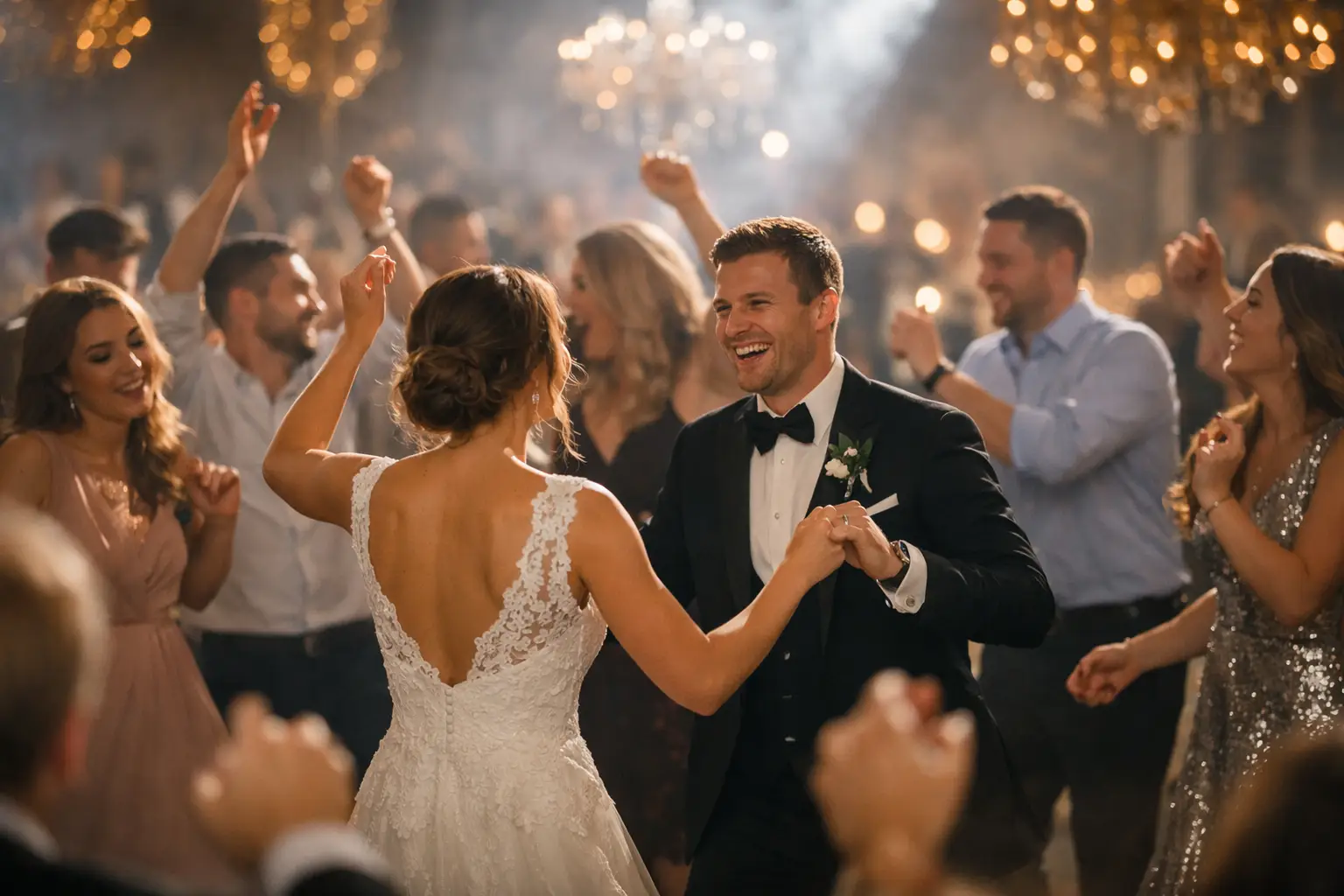
A packed dance floor rarely starts with one magic song. It starts with a DJ who knows what songs fill dance floors for the people actually in the room – your college friends, your parents, your coworkers, the cousins who came ready to party, and the guests who need one familiar chorus before they step out.
For weddings and private events, the best music is never just a copied playlist of popular songs. It is a well-timed mix of recognizable favorites, meaningful requests, cultural moments, and high-energy transitions that give guests a reason to stay on the floor. The goal is not to play every hit. The goal is to create the feeling that nobody wants to miss what happens next.
What Songs Fill Dance Floors? Songs Guests Know
The songs most likely to bring guests together have one thing in common: people recognize them quickly. A long instrumental intro can work later in the night for a committed crowd, but early dance-floor songs need to make their point fast. When guests hear a beat, lyric, or hook they know within seconds, hesitation turns into movement.
That is why sing-alongs remain such a powerful tool. Tracks like September, I Wanna Dance with Somebody, Yeah!, Mr. Brightside, Don’t Stop Believin’, and Dancing Queen can unite different age groups because they give everyone something to do. Guests do not have to be great dancers when they can clap, sing, point at a friend, or shout the chorus together.
Current music matters too, especially when the room includes younger guests, but it works best when it is balanced with songs that have already proven themselves across generations. A wedding dance floor can lose momentum when the playlist becomes too narrowly focused on one decade, genre, or friend group. The strongest sets create common ground.
A Great Dance Floor Is Built, Not Pressed Play
Music selection matters, but song order matters just as much. A DJ can play two excellent songs back-to-back and still empty the floor if the energy shift is too abrupt. Think of the dance floor as a conversation. Guests need a reason to join, a reason to stay, and occasional breathing room before the next big moment.
Early in the reception, a smart DJ often uses upbeat, approachable songs that pull people in without demanding full nightclub energy. Motown, disco, pop classics, and feel-good party tracks work well here. Once the floor has a foundation, the music can build into hip-hop, dance pop, Latin hits, throwbacks, rock anthems, or club-ready tracks based on how guests respond.
The best DJs do not force a preplanned sequence when the room says something different. If a 90s sing-along suddenly brings every guest to the floor, that is a clue to stay in that lane a little longer. If a high-energy electronic track gets polite head nods but no movement, it may be time to pivot. Reading the room is the difference between a playlist and live entertainment.
The first few songs set the tone
After formal dances and dinner, guests often need a clear invitation to participate. This is not always the moment for the couple’s most obscure favorite song, even if it is meaningful. Start with a familiar, celebratory track that gives people permission to get up. Once the dance floor looks active, personal favorites and deeper cuts can land much better.
A full floor also creates its own momentum. People are naturally drawn toward movement, laughter, and a crowd singing at the top of its lungs. That is why an experienced MC and DJ team watches the room closely, makes the right announcements at the right time, and avoids interrupting a great run of music just to follow a rigid schedule.
The Best Genres Depend on Your Guests
There is no universal wedding playlist, and that is good news. Your event should sound like your people. A multicultural family celebration in Bergen County may come alive when merengue, salsa, bachata, reggaeton, and cumbia enter the mix. Another wedding may peak with 2000s pop-punk, country line dances, classic rock, or Jersey club energy.
For bilingual and Spanish-speaking households, Latin music should never feel like an afterthought or a short themed segment. When it is part of your family’s story, it belongs naturally in the night’s biggest moments. The same goes for LGBTQ celebrations, cultural traditions, and music tied to the couple’s community. Inclusive entertainment means giving guests music that feels like home while still bringing the entire room along.
A few genres consistently earn their place because they are social, recognizable, and easy to move to:
- Disco and funk bring instant positivity, especially for mixed-age wedding crowds.
- 80s, 90s, and 2000s throwbacks spark nostalgia and big group sing-alongs.
- Hip-hop and R&B can raise the energy fast when the DJ chooses clean edits and reads the audience.
- Latin dance music creates rhythm-driven moments that invite couples, families, and friend groups onto the floor.
- Pop anthems and wedding staples give every guest a familiar entry point.
The trade-off is variety versus flow. Playing one song from every genre can feel scattered. Staying in one genre too long can leave part of the room behind. A skilled DJ connects those styles with purpose, so the night feels personal instead of random.
Requests Matter, But Timing Matters More
Most couples have a few non-negotiable songs, and they should. Your wedding or party deserves music that reflects your relationship, your friends, and your family traditions. A must-play list helps your DJ understand the heart of the celebration.
Still, a request is not always a next-song request. A sentimental ballad may be perfect when couples are already dancing together, but it can stall a peak party set. A niche favorite may delight your closest friends, but it may work better after the floor is established. Trusting your DJ with timing gives your favorite songs the best chance to become real memories rather than missed moments.
Your do-not-play list is equally useful. It prevents awkward surprises and tells the entertainment team where your boundaries are. Be clear about explicit lyrics, genres you dislike, songs connected to past relationships, and anything that simply does not fit your event. Good planning gives the DJ direction. Professional experience turns that direction into a night that moves.
Do not underestimate special dances and traditions
A dance floor does not only fill during open dancing. The right grand entrance, first dance, parent dance, anniversary dance, Hora Loca, or group participation song can bring guests into the action and build anticipation for what follows.
These moments work best when they feel intentional, not overproduced. A surprise can be memorable, but it should match the crowd and the couple. The same is true for line dances and group songs. They can be a huge win when your guests love them, or a quick reset when they do not. An experienced DJ reads whether to extend the moment or move on before the energy drops.
Give Your DJ the Information That Changes Everything
The easiest way to get a packed floor is to share more than a list of songs. Tell your DJ who will be there. Will your guests skew older, younger, bilingual, music-obsessed, reserved at first, or ready to dance before dinner is cleared? Are there family members who will expect certain cultural songs? Is there a friend group that knows every word to early 2000s hits?
Also share the event flow. A short reception with limited open dancing needs faster pacing than a six-hour wedding. A formal ballroom crowd may need a warmer build than a birthday party in a more casual setting. Lighting, room layout, and photo booth placement can affect traffic and energy too. Entertainment works best when the whole experience is coordinated.
At Electrified DJ Services, that coordination is part of the job. Music, MC direction, lighting, photo experiences, and event flow should support the same outcome: guests who feel welcomed, energized, and fully present for your biggest moments.
The songs that fill your dance floor will not be exactly the same as anyone else’s. Give your entertainment team the stories, sounds, and family traditions that matter to you, then leave room for them to respond to the magic happening in the room.